

Most people shopping for a safety razor are trying to fix one of two problems. Either cartridges keep leaving razor burn and ingrown hairs along the neck, or the cost of refill packs finally got annoying. Both problems point to a safety razor. Where people go wrong is the model. A razor that suits a thick, coarse beard can chew up sensitive skin, and a mild razor can feel useless on dense stubble.
Table Of Contents
−- Best safety razors at a glance
- The best safety razors, and who each one is for
- Edwin Jagger DE89, best first safety razor for most people
- Henson AL13, best for sensitive skin and nick-prone shavers
- Bevel Safety Razor, best for coarse or curly hair prone to razor bumps
- Rockwell 6C, best adjustable razor for learning
- Merkur 34C, best heavy razor with a short handle
- Parker 99R, best butterfly razor
- Merkur Futur, best for experienced shavers with coarse beards
- Muhle R41, most aggressive razor for thick beards
- How to choose a safety razor for your skin and beard
- Why switch from cartridges at all
- Frequently asked questions
- Which safety razor to buy
So we sorted these picks by the skin and beard each one actually suits, not by price or brand name. If you are buying your first one, start with the table, find the row that describes you, and read that pick.
Best safety razors at a glance
| Razor | Best for | Key spec |
|---|---|---|
| Edwin Jagger DE89 | First safety razor, normal skin | Mild, three-piece closed comb |
| Henson AL13 | Sensitive skin, frequent nicks | 37 g aluminum, blade supported to the edge |
| Bevel Safety Razor | Coarse or curly hair with razor bumps | Mild, solid bar, 88 g |
| Rockwell 6C | Beginners who want room to grow | Six settings, R1 to R6 |
| Merkur 34C | Weight without a long handle | Two-piece, short heavy handle |
| Parker 99R | Easy twist-to-open loading | Butterfly, about 3.4 oz brass |
| Merkur Futur | Experienced shavers, coarse beards | Dial adjustable, about 4.4 oz |
| Muhle R41 | Very thick beards, experts only | Open comb, aggressive |
The best safety razors, and who each one is for
Every razor below takes standard double edge blades, so you are never locked into one brand of refill. The difference between them comes down to how much blade the head exposes, how heavy the razor is, and how the blade loads.
Edwin Jagger DE89, best first safety razor for most people

The DE89 is the razor we point most first-time buyers toward, and the reason is boring in a good way. It is a three-piece closed comb razor with a mild head, so the guard bar keeps the blade from biting into skin while you are still learning the angle. Mistakes cost you a little irritation, not a deep nick.
It is also simple. Unscrew the handle, drop the blade onto the base plate, screw it back together. No moving parts to wear out. The head is chrome plated zinc alloy, which is common at this price and lasts for years if you dry it after each shave, since the plating is the only thing protecting the metal underneath, a point we cover in our guide to how long a safety razor actually lasts.
Good for
- Beginners moving off cartridges
- Normal to mildly sensitive skin
- Light to medium beards
Skip it if
- You have a very dense, wiry beard and already shave with a safety razor, since the mild head may need extra passes
Henson AL13, best for sensitive skin and nick-prone shavers
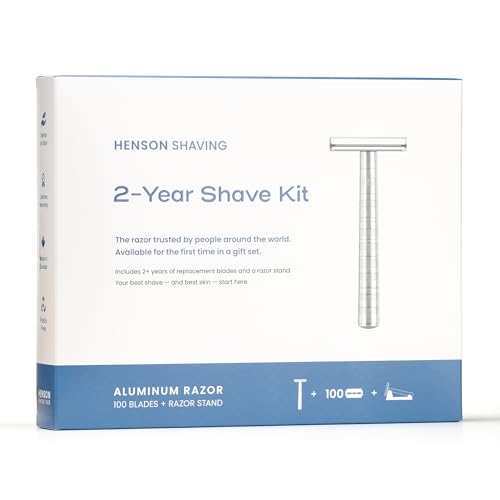
Henson’s design solves the problem that makes most beginners hate safety razors, which is blade flex. The head supports the blade almost right up to the cutting edge, so the edge cannot flex into the skin, and that is what makes the AL13 so hard to cut yourself with. It is the razor wet shaving forums and most current buying guides recommend first for sensitive skin, and the design explains why.
It is machined from aerospace grade aluminum in Canada and weighs only 37 grams, so it feels very light next to brass or zinc razors. You pick the head when you buy. Henson says the Mild+ is for finer hair and the Medium++ for coarser hair. Most men shaving their face want the Medium++.
Good for
- Sensitive skin that reddens after cartridges
- Anyone who keeps nicking the chin and jawline
- Travel, since there is no plating to chip
Skip it if
- You like a heavy razor that does the work with its own weight
- You want to adjust aggressiveness later, the head is fixed
Bevel Safety Razor, best for coarse or curly hair prone to razor bumps
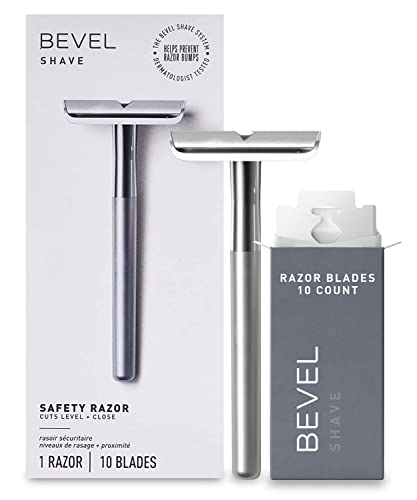
Bevel built this razor for men with coarse, curly beards, the group most likely to deal with pseudofolliculitis barbae, the medical name for chronic razor bumps. The American Academy of Dermatology notes that a single-blade razor or an electric razor is often recommended for men prone to razor bumps. The reason is mechanical. Multi-blade cartridges lift and cut curly hair below the skin line, where it can curl back in.
The Bevel is a three-piece razor with a solid safety bar and a mild head. At 88 grams and with a brass-weighted body, it has enough heft to cut with almost no pressure, which matters because pressing down is one of the fastest ways to irritate bump-prone skin. Its weak point is the handle. Owners find it thin and slick, so wet hands need a careful grip.
Good for
- Coarse or curly hair that grows back into the skin
- Men with darker skin tones prone to bumps and dark marks
- First-time wet shavers who want a mild head
Skip it if
- A textured, grippy handle matters to you, since this one is smooth
Even the right razor will not stop bumps if you shave against the grain, so pair it with the technique in our guide to choosing your shaving direction by hair type. If you are still weighing a razor against salon waxing for the same coarse or curly hair, our shaving versus waxing comparison covers which method is safer for ingrown-prone skin.
Rockwell 6C, best adjustable razor for learning
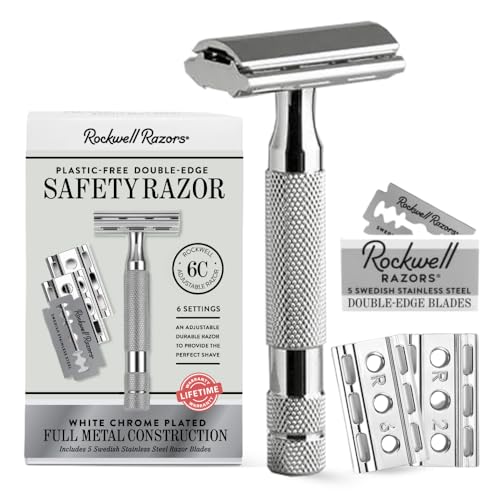
The 6C is for the buyer who does not know yet how aggressive a razor they need. It comes with three double-sided base plates, giving six settings from R1, the mildest, to R6. You start low, learn the angle, and move up a plate when the shave stops feeling close enough. That is cheaper than buying a second razor six months in.
It weighs about 95 grams, made from chromed zinc alloy, and runs 97 mm long. That short, heavy build gives it good control around the nose and chin. Some owners report plating wear over time, so dry it after each shave. Rockwell also makes a stainless steel version, which we cover in our Rockwell 6S review.
Good for
- Beginners who expect to want a closer shave later
- Households where two people with different beards share one razor
Skip it if
- You want to swap blades fast, since changing plates means taking the head apart
Merkur 34C, best heavy razor with a short handle

The 34C has been a safety razor standard for decades. It is a two-piece razor, meaning the handle and base plate are one unit and you just unscrew the top cap to swap blades. The handle is about three inches long and heavy for its size, so the weight sits close to the head.
That balance is the point. A short, dense razor makes tight areas like the upper lip and jaw corners easier to control, and the weight means you barely need to press. The head is mild to medium, a step up from the DE89 but still forgiving. If you have large hands, the short handle can feel cramped.
Good for
- Men who want weight without a long handle
- A forgiving razor that still handles a medium beard
Skip it if
- You have large hands and prefer a 4 inch handle
Parker 99R, best butterfly razor
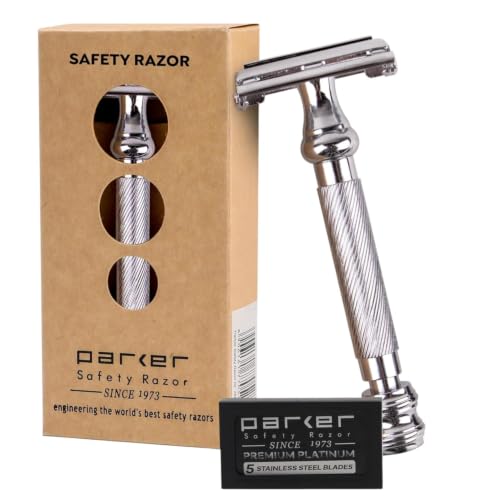
A butterfly razor opens at the head when you twist the knob at the bottom of the handle. No unscrewing, no loose parts in a wet sink. The Parker 99R is a heavy one, about 3.4 ounces of chrome-plated brass with a textured handle. Brass will not corrode the way an exposed zinc alloy does if the plating chips.
The head shaves mild to medium, and the weight does most of the work. The tradeoff with any butterfly is the moving mechanism, which can loosen over years of use. We go deeper in our Parker 99R review, and if you have settled on the twist-to-open style, our best butterfly safety razors list compares more options.
Good for
- Anyone who finds three-piece razors fiddly to load
- Shavers who want a heavy razor that cuts with no pressure
Skip it if
- You want the most durable design possible, since fixed-head razors have nothing to wear out
Merkur Futur, best for experienced shavers with coarse beards
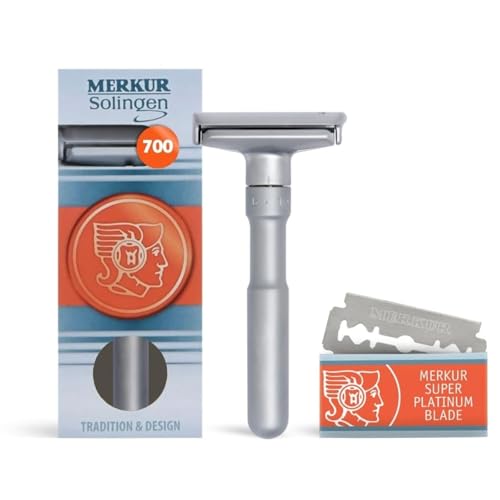
The Futur has six settings, and you change them by turning a dial on the head. Unlike the Rockwell, there are no plates to swap. At about 4.4 ounces it is one of the heaviest razors you can buy, which helps on a thick, coarse beard because the weight carries the blade through without you pressing.
That size is also its limit. The head is large and blocky, so it is hard to steer under the nose and around the chin, and some owners find it awkward in a small hand. We see it as a razor for someone who already shaves with a safety razor and wants one tool that runs from gentle to very aggressive.
Good for
- Dense, coarse beards
- Experienced shavers who want one razor for every setting
Skip it if
- This is your first safety razor
- You have a narrow face or small hands
Muhle R41, most aggressive razor for thick beards
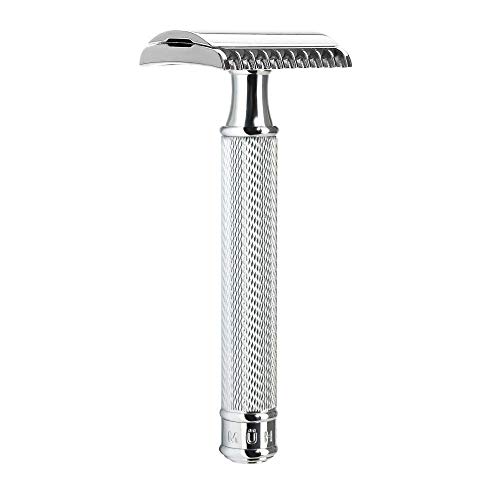
The R41 is an open comb razor, meaning the guard has teeth instead of a solid bar. Those teeth let long, dense stubble reach the blade before it gets flattened. Owners widely rank the current R41 among the most aggressive razors in regular production. In practice that means a very close shave in fewer passes, if your angle is right.
If your angle is wrong, it will tell you quickly. We do not recommend this as a first razor, and it is the wrong pick for sensitive or bump-prone skin. It is for someone who has already learned on a mild razor, shaves every few days, and finds milder heads leave stubble behind.
Good for
- Very thick beards and several days of growth
- Experienced wet shavers who want fewer passes
Skip it if
- You are new to safety razors
- You have sensitive skin or get razor bumps

How to choose a safety razor for your skin and beard
Three specs decide whether a safety razor works for you. The rest, like finish, color, and box, is preference.
Blade exposure and gap
Blade gap is the distance between the safety bar and the blade edge, and exposure is how far the edge sticks out past the line between cap and guard. Together they decide how “aggressive” a razor is. A mild head cuts less per stroke and forgives a bad angle. An aggressive head cuts closer, faster, and punishes mistakes. If the terms are new, our glossary of wet shaving terms explains closed comb, open comb, and blade gap in plain language.
Sensitive skin and bump-prone beards almost always do better on a mild head. Thick, coarse beards that grow fast can justify medium or aggressive. If you are unsure, an adjustable razor like the Rockwell 6C lets you find out without buying twice.
Weight and handle length
A heavier razor cuts with its own weight, so you press less, and pressing harder does not get you a closer shave anyway. That matters more than most buyers realize, because pressure is what turns a good blade into irritated, inflamed follicles. Light razors like the Henson are still excellent, but they ask you to keep a light touch on purpose. Short handles give control in tight spots, and longer ones suit large hands and body shaving.
How the blade loads, and what the razor is made of
Three-piece and two-piece razors have no moving parts and last the longest. Butterfly and dial-adjustable razors load and adjust faster, but have mechanisms that can loosen over time. Material matters too. Stainless steel and brass hold up for decades. Chrome-plated zinc alloy is fine as long as the plating stays intact, so dry the razor after every shave and follow our guide to cleaning a safety razor.
Match the razor to your situation
Here is the short version, by reader.
- First safety razor, normal skin: Edwin Jagger DE89
- Sensitive skin or constant nicks: Henson AL13
- Coarse, curly hair with razor bumps: Bevel
- Not sure how aggressive you need: Rockwell 6C
- Thick beard, already experienced: Merkur Futur or Muhle R41
A safety razor is not the only answer for every reader. If your bumps persist even with a mild single blade and good technique, the AAD also lists electric razors as an option, and our comparison of a safety razor versus an electric razor for sensitive skin covers when the electric wins. For a broader look at cost and skin type, see our wet shaving versus dry shaving breakdown.
Why switch from cartridges at all
Two reasons, cost and skin. A double edge blade costs a fraction of a cartridge refill, and our safety razor versus cartridge breakdown runs the numbers. A cheap disposable also dulls fast, often within a few shaves, as our look at how long a disposable razor lasts shows, and the AAD warns that a dull blade greatly increases the risk of razor bumps. For the full cost and waste comparison, see our safety razor versus disposable razor guide.
The skin side comes down to mechanics. One blade cuts the hair once, at the surface, instead of tugging it up and slicing it below the skin line. Our breakdown of how a razor actually cuts hair explains why that matters for ingrown hairs. The tradeoff is a short learning curve. Most men find the angle within a couple of weeks, and our guide to learning to shave with a safety razor walks through the first shaves.
Frequently asked questions
These are the questions buyers ask most once they have narrowed down a razor.
Are safety razors dangerous for beginners?
Not when you start with a mild head and a light touch. The guard bar is what makes it a “safety” razor, a design that dates back to the early 1900s, and it does the job your hand would otherwise have to learn, which is the core difference when weighing a safety razor against a straight razor’s fully exposed edge. Most early nicks come from pressing too hard or holding the angle too steep. Our piece on whether safety razors are dangerous covers the common mistakes.
How long does a safety razor last?
The razor itself can last a very long time, often decades for stainless steel and brass. The blade is different. Change it every five to seven shaves, the same range the AAD gives, and sooner if it starts to tug. Our guide on how often to change a safety razor blade explains what actually dulls it.
Which blades should I use?
Any standard double edge blade fits every razor on this list. Blades vary a lot in sharpness and smoothness, though, and the right one depends on your skin. Our list of the best double edge razor blades sorts them by who each one suits. Sharper blades usually feel smoother on coarse beards, while sensitive skin often prefers a smoother, slightly less keen edge.
Is a shavette easier than a safety razor?
No. A shavette has no guard bar, so it is closer to a straight razor than a safety razor. For most first-time buyers the safety razor is the better start, and our comparison of a shavette versus a safety razor explains why the blade gap is the real difference.
Can I take a safety razor on a plane?
The TSA allows a safety razor in a US carry-on bag only without its blade, so pack double edge blades in checked luggage. In a damp toiletry bag, brass and stainless steel razors also resist rust better than plated zinc.
Which safety razor to buy
If you only buy one, buy for your skin rather than for the reviews. Most first-time buyers with normal skin should get the Edwin Jagger DE89. Anyone whose skin reddens or bumps after every shave should start with the Henson AL13 or the Bevel and shave with the grain until the bumps stop.
Last update on 2026-10-14 / Affiliate links / Images from Amazon Product Advertising API
Affiliate Disclosure: This post contains affiliate links, which means I may receive a small commission, at no extra cost to you, if you make a purchase using these links.

Jay Kang
Just because i'm asian does not mean I don't need shaving. I always wanted to grow a beard when I was young, now I need to shave because hair growth for me is a problem. I'm going through what every man will and has gone through before.


